Human behavior is finite. Temporal Determinism is Discernible.
Originally published on LinkedIn Download PDF
Today I published Scenometry: Understanding and Creating Temporal Determinism as an open preprint. It is a 224-page monograph, it is free to download, and it is written to be tested.
Free download: https://zenodo.org/records/23008798 (DOI: 10.5281/zenodo.23008798)
Behavioural science has long worked from Kurt Lewin’s field equation: behaviour is a function of the person and the environment. Lewin named the relation. Scenometry states its inputs in a form that can be observed, scored and tested, and follows them through time.
The idea in five terms
Scene. A scene is any observed situation in front of a person: a kitchen, a meeting room, a street, a film. It can be met in person or on a screen. Recorded scenes matter because the same frames can be read again, by more people and by a machine, so observation becomes measurable and repeatable.
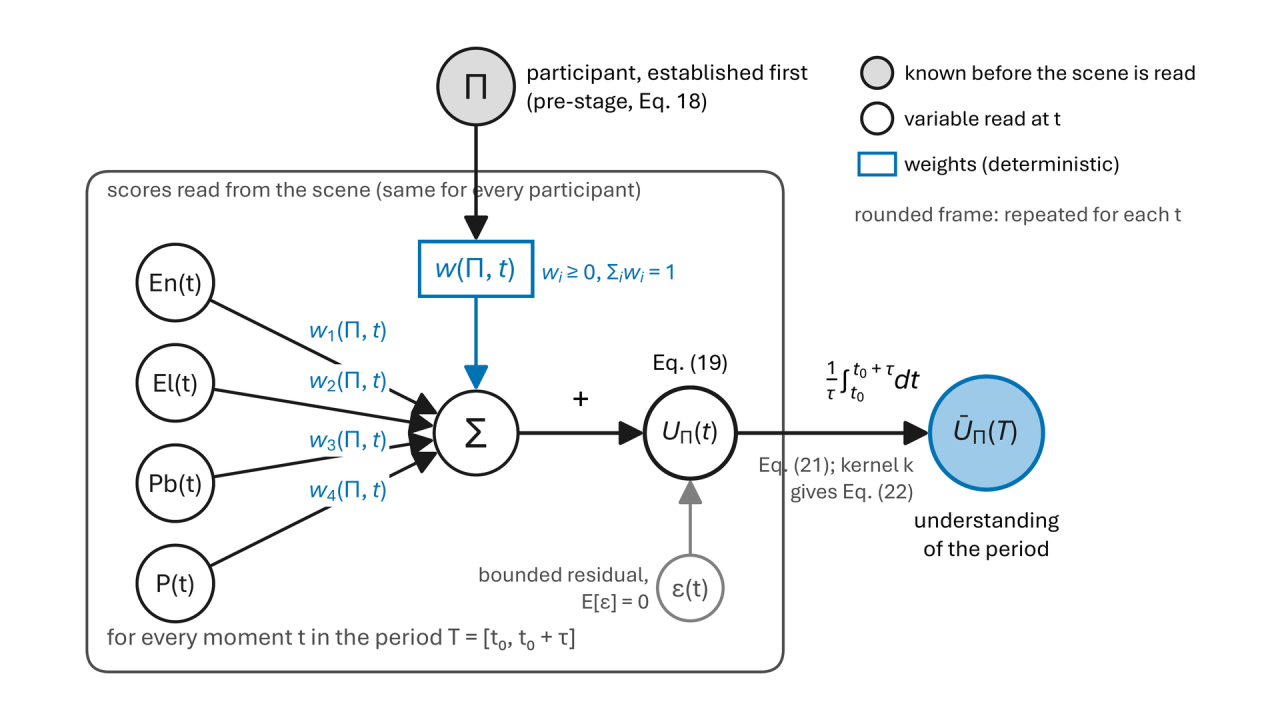
Participant. The person reading the scene. I write the participant as Π and establish the participant first, because the same scene reads differently to different people, and that difference belongs in the model, not in the noise.
Prior behaviour. What happened before the moment you are looking at. A dinner table laid with the dessert fork the wrong way round is a trace of what the host did earlier. Prior behaviours (Pb) are one of four inputs, beside the environment (En), the elements in it (El) and the persons in it (P). Together they give Equation One:
U = f(En, El, Pb, P | Π)
Understanding, U, is a score between 0 and 1. Its working form is a weighted sum of the four scores, with weights that are never negative and sum to 1, plus a residual with a mean of zero. The weights carry a Dirichlet prior that is updated by counts, so every test adds evidence.
Finite behaviours. Every dimension of human perception reaches a fixed end point, which I call a fixed MIP: grey levels, colours, concurrent sound streams, working memory, conscious throughput, facial actions and motor synergies. Beyond that point, more resolution gives the human observer nothing. The scenes a person can tell apart therefore form a finite set, and so do the behaviours that answer them. The book proves this as Proposition 4.1.
Temporal determinism. Write the equation over time and the thesis follows: with the participant known and the scene read, what happens next is fixed, within a residual, by what has been read so far. The criterion is sufficiency, not omniscience. The threshold is 90%, and what falls outside the pattern is carried by the residual term. The task is computation.
Where I part company with the prevailing view
The prevailing assumption is that human behavior is open-ended and, beyond short horizons, unknowable in advance. I take the opposite position deliberately, and the published evidence supports it.
Understanding forms below awareness. Natural scenes are categorized within about 150 milliseconds. Faces are judged after 100 milliseconds. Choices can be decoded from brain activity seconds before the person makes them. The body answers before the mind does. Faces shown for 30 milliseconds, too briefly to be seen, are answered by the muscles of the observer’s own face. Behavior runs on its own past. In diary studies, about 43% of everyday behaviours was repeated almost daily in the same place. The movements of 50,000 mobile-phone users are regular enough to be anticipated 93% of the time. Human perception is bounded; a camera’s is not. The eye resolves fine detail only in the central 2° of the visual field. A camera and a computer register every pixel of every frame at once.
Every one of these findings is published, and every one is cited in full in the book. Put together, they describe a system that is fast, shared, bounded and carried forward by its own history. That is a system that can be read.
The model is checked as well as argued. A suite of 168 computational checks accompanies the book and reports 0 failures. Twelve cases of irrational-looking behaviours are restated with the inputs present at the time. Irrational-looking is not the same as unreadable.
The dinner-table test: run it yourself
The clearest evidence is also the simplest, and I want you to run it.

Lay a dinner table as if guests are about to arrive. Choose a place mat, the cutlery and a layout for the dessert spoon and fork: cheap or expensive, new or worn, the right way round or the wrong way round. Build any setting you like. The 18 combinations in the book are one illustrative set, and every tester should mix, match and change them.

Then ask two or more people to look at it. Put a partition between them, or use separate rooms, so that no one sees anyone else’s scores. Ask for quick answers, each from 1 to 10:
How smart is the host? How rich is the host? How important are the guests?
Compare the scores only when everyone has finished. There is no right answer. What matters is agreement. If people scored at random, two scores would fall within 2 points of each other 44 times in 100. In my practitioner record of more than 300 sessions, the scores fell within 2 points of each other in 92% of sessions (Wilson 95% interval 88.4% to 94.6%). High or low, 5 to 7, 8 to 9 or 2 to 4, observers land together, unknowingly and unconsciously. The test works best when answers are quick, and allowing more time has not weakened the result.
In the terms of the equation, the table is a scene. The environment is fixed and the elements vary. The layout is a trace of the host’s prior behavior, and the host, who is not in the room, is read from the table alone. Observers agree because they share the same preconfigured weights, built over thousands of years of human development.
A pre-registered controlled replication is planned, designed for at least 5,000 participants. It pairs settings that each tester builds with anchor settings from the book, and it has a quick condition (10 seconds to view, 15 seconds to score) and an extended condition. You do not need to wait for it. Build your own setting, run it with friends, colleagues or students, and see where the scores land. If you run it, send me the result.
Why this matters
There are over a trillion hours of video online, and the total grows every hour. Detecting the objects in a frame is one step. Understanding the scene is the breakthrough, and Scenometry gives understanding a structure: four observable inputs, a participant established first, and weights that learn from every test. I hold five examined and granted patents in this field, on 3D media elements in 2D video, and this monograph states the science of reading the scene itself.
Read it, test it, review it - Download It
The full monograph is free at https://zenodo.org/records/23008798 (DOI: 10.5281/zenodo.23008798). For each step of the argument it states what evidence would confirm or refute it, and it sets out the next tests as a research agenda.
I have published it as a preprint because I want it read, tested and reviewed by researchers in psychology, cognitive science, computer vision and philosophy of mind. If you work on how people read scenes, I would value your review. Share it with anyone who does.
Roy Taylor, Founder and CEO, Framecore. ORCID: https://orcid.org/0009-0001-6977-8588