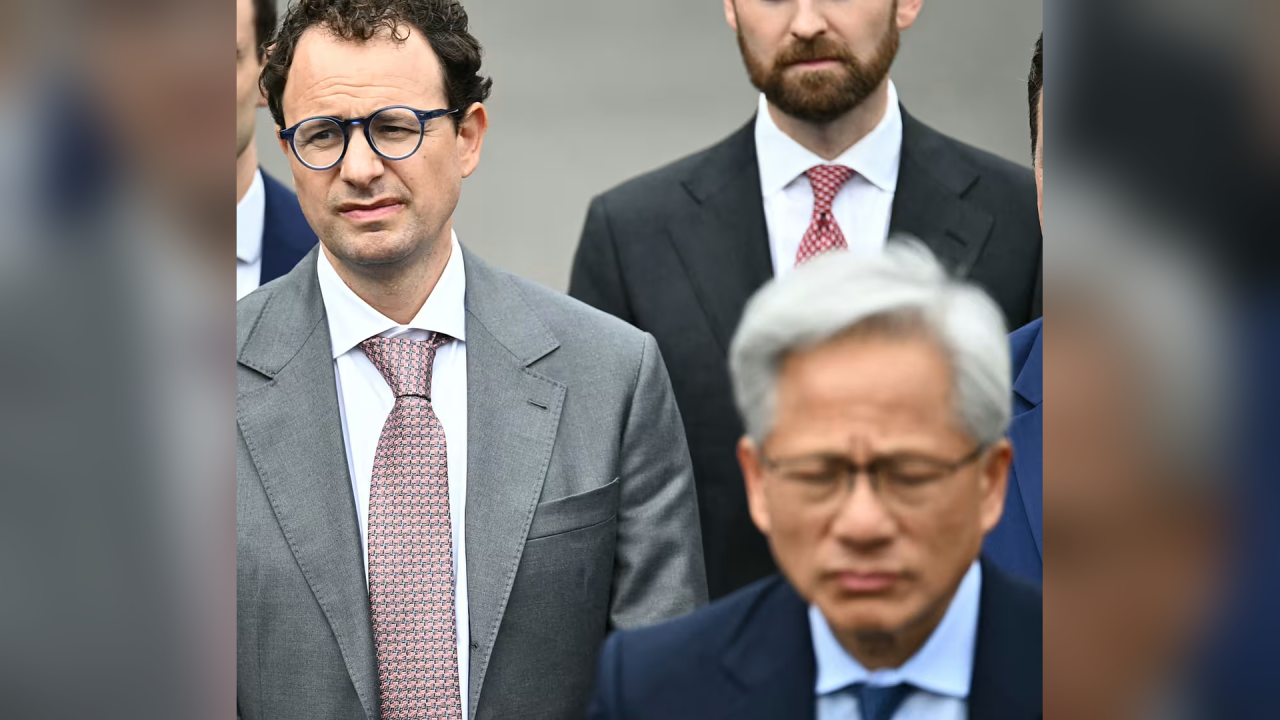
Jensen Huang. Dario Amodei - Anthropic. Its About GPUs and a 100M Unit Shortage.
Originally published on LinkedIn Download PDF
I wrote on X that 'Dario [Anthropic CEO] considers every GPU not supplied to him was one he should have been given'. I stand by that. A new CEO at NVIDIA would, I am sure he believes, mean him getting more GPU's.
In January I wrote (here on LinkedIn) that we were 60 million GPUs behind what is needed. Since then AI usage has roughly doubled, the chip makers have shipped record volumes, and the gap has not closed. Its grown. It is now a 100M. Worse that number is going to grow further still.
Disclosure; I was the founder in Europe for NVIDIA and worked there from 1998 until 2010. Jensen and I knew each other extremely well during that time. Later I went to work at AMD and became a competitor. I have sold GPU's, helped build their ecosystems, seen NVIDIA from almost every angle and today I use NVIDIA GPU's 24 hours a day inventing Temporal Determinism. Just recently I am working with Google Cloud and the team are using TPU's.
What happened to Jensen and NVIDIA, I believe, falls back to one simple thing. Who gets GPU allocation. Dario Amodei cannot be blamed for wanting more. Anthropic growth is throttled by lack of supply.
It seems to me that Dario's strategy is to create the circumstances for Anthropic to get GPU allocation. Stop the GPU's going anywhere else, including China. Stop Jensen being able to decide where they go and stop Jensen creating an ecosystem that Anthropic cannot control.
Because no one is talking about the criticality of the acute GPU shortage.
Why it matters: when there are not enough chips, providers ration compute per answer. Fewer tokens per answer means shorter reasoning, and shorter reasoning means more confident wrong answers. The hardware count is the root of the trust problem. Restoring a compute-rich, early-days experience at today's scale needs roughly 100 million H100-class GPUs. The world will have about 46 million by the end of 2026. The gap is 55 to 75 million minimum.
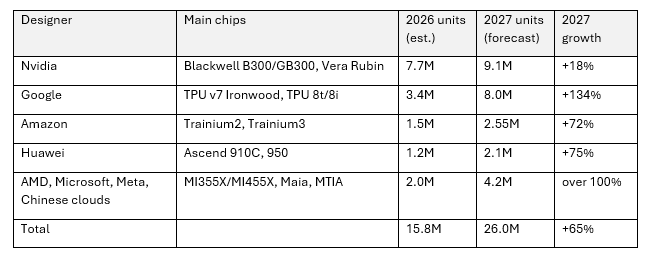
The trend is the problem. Token demand is growing about 7 times a year. New compute capacity is growing about 2.5 times a year, doubling every nine months . Efficiency fills part of the difference (Google cut Gemini serving unit costs by 78% ), and rationing fills the rest. The industry will ship about 16 million high-end AI accelerators in 2026 and about 26 million in 2027. In compute terms, new capacity added each quarter rose from 0.8 million H100e in Q1 2024 to 6.3 million in Q2 2026 : a pace of about 25 million H100e a year.
Why it matters
When there are not enough chips, providers ration compute per answer. Fewer tokens per answer means shorter reasoning, and shorter reasoning means more confident wrong answers. The hardware count is the root of the trust problem.
Public First & Public First Action is a lobby group for laws that would see Anthropic get more GPU's. Under the pretense of 'protecting the public' they work to get laws passed that only they, and few others, can pass.
With no access to the ear of Trump that does not involve Jensen, Dario has been charming and helping the Democrats. Including free access to large GPU arrays. The Federal Election Commission filings reported by Politico show Dario Amodei donated $1 million in May 2026 to Public First, a super PAC backing candidates who support mandatory AI safeguards. Public First operates under the bipartisan 501(c)(4) Public First Action, to which Anthropic donated $20 million in February 2026 for public education on AI policy (and up to $40 million overall, according to a November 2026 Washington Post post). Public First also transferred over $3 million to the affiliated Jobs and Democracy PAC, which spent $12 million supporting Democrat Alex Bores in a New York congressional primary
But this isn't about left or right, It remains about GPU allocation.
Promoting fears about AI has one purpose. Get 'controls' in place that favor GPU allocations to 'trusted' domains and partners. Same again. More parts for Anthropic.
Here is a brief history:
AI Regulation and "Doomerism". In mid-2025, Huang accused Dario (and some others) of creating "too much drama" with unscientific doomsday predictions, claiming that heavy lobbying for AI regulation was a self-serving attempt to stifle open-source competition and capture the industry. Amodei fired back on Fortune , calling Huang's characterization an "outrageous lie". He rejected the "doomer" label and argued his push for safety standards and "responsible scaling policies" was driven by genuine urgency rather than a desire to slow down progress. [1 , 2 ] Job Displacement Warnings. The two leaders openly contradicted each other on AI's economic fallout. Amodei repeatedly warned that advanced AI could trigger massive job losses, particularly wiping out entry-level white-collar roles. Huang publicly stated he disagreed with almost everything Amodei said on the topic, maintaining a much rosier outlook that AI would transform jobs and drive productivity rather than cause mass unemployment. [1 ] White House Tech Summit Confrontation. Tensions boiled over privately in October 2026 following a White House luncheon hosted by President Donald Trump. Huang and several other tech executives directly confronted Amodei over his severe public warnings about AI risks, with reports noting Huang was deeply upset by how Amodei's rhetoric could invite heavy-handed government intervention. [1 , 2 , 3 ] AI Chip Sales to China. The executives also took opposing stances on U.S. export controls. Amodei advocated for strict limits on selling advanced AI chips to China on national security grounds. Huang openly rejected Amodei's push to cut off the Chinese market, arguing that restricting American companies only hurts U.S. tech leadership while allowing foreign competitors to fill the void
Jensen wants an open market with open models that support mad, crazy inventors like myself. I want to go on record as saying now, I have proven Temporal Determinism is real, demonstrable and ready to build at scale. It is a Frontier Model with a suite of LLM's and its own neural network. There is simply no way that could be built without open models and access to new tools. Because let us be very clear, Dario wants these regulated.
Restoring a compute-rich, early-days experience at today's scale needs roughly 100 million H100-class GPUs. The world will have about 46 million by the end of 2026. The gap is 55 to 75 million.
I count in H100-equivalents (H100e) because a Blackwell, Rubin or TPU does the work of several H100s. Counting boxes would flatter the newer chips and hide the shortfall.
Demand has outrun January's numbers
ChatGPT passed 1 billion weekly users in July; Gemini passed 1 billion monthly users in August .
Google processed 9.7 trillion tokens a month in 2024, 480 trillion in May 2025 and 3.2 quadrillion in May 2026 . That is roughly 330 times in two years.
Google's model APIs alone now run at nearly 32 billion tokens a minute, more than four times a year ago .
The arithmetic, updated
Daily AI users, all systems combined: about 1 billion (January: 500 million).
Peak concurrency at 1%: 10 million live sessions.
Early-days experience at 0.05 GPU per session: 500,000 GPUs active at peak.
Real-world overhead of 10 to 20 times (redundancy, geographic replication, burst capacity, fine-tuning, safety): 5 to 10 million GPUs per major ecosystem.
Ten to twelve hyperscale ecosystems: 50 to 120 million GPUs. My working figure is 100 million.
That is before agents. An agent runs for minutes or hours, calls tools and reasons in loops, so one user can now consume what a hundred did in 2023.
What exists today
In January I put the installed base at 1 to 3 million high-end GPUs. Epoch AI's chip-sales data shows a much larger base, so I have brought that figure up to date: about 27.6 million H100e had been sold by June 2026, heading for about 46 million by year end .
The trend is the problem. Token demand is growing about 7 times a year. New compute capacity is growing about 2.5 times a year, doubling every nine months . Efficiency fills part of the difference (Google cut Gemini serving unit costs by 78% ), and rationing fills the rest.
How many are being made: about 16 million this year, 26 million next
The industry will ship about 16 million high-end AI accelerators in 2026 and about 26 million in 2027. In compute terms, new capacity added each quarter rose from 0.8 million H100e in Q1 2024 to 6.3 million in Q2 2026 : a pace of about 25 million H100e a year.
He who gets the GPU's wins. In almost everything.
Roy Taylor, Los Angeles, November 24th, 2026
I have spent my entire career in GPUs: starting with Inmos, the inventor of the worlds first parallel processor, then IBM Microelectronics, (they were not called GPU's) then at NVIDIA in Europe, working out of my bedroom in 1998. Later running global channel sales for the old ATI and establishing AMD Studios in Hollywood. I used GPU's for, inventing VPP AI in advertising with Ryff, and today building a new foundational AI called Temporal Determinism.